

Learning poker hand rankings is the most important skill any Texas Hold’em player needs to master. Without knowing which hands beat others, players cannot make good decisions at the table or understand when to bet, fold, or raise.
The standard poker hand rankings apply to all forms of Texas Hold’em, from royal flush at the top down to high card at the bottom. These rankings never change, whether someone plays cash games or tournaments. Every player uses the same five-card hand system to determine winners.
This guide covers everything from the strongest possible hands to the weakest combinations players might hold. It also explains which starting hands give players the best chance to win, how tie-breakers work, and the math behind each hand type. Understanding these basics helps players move from beginners to confident competitors who can read the strength of any situation.
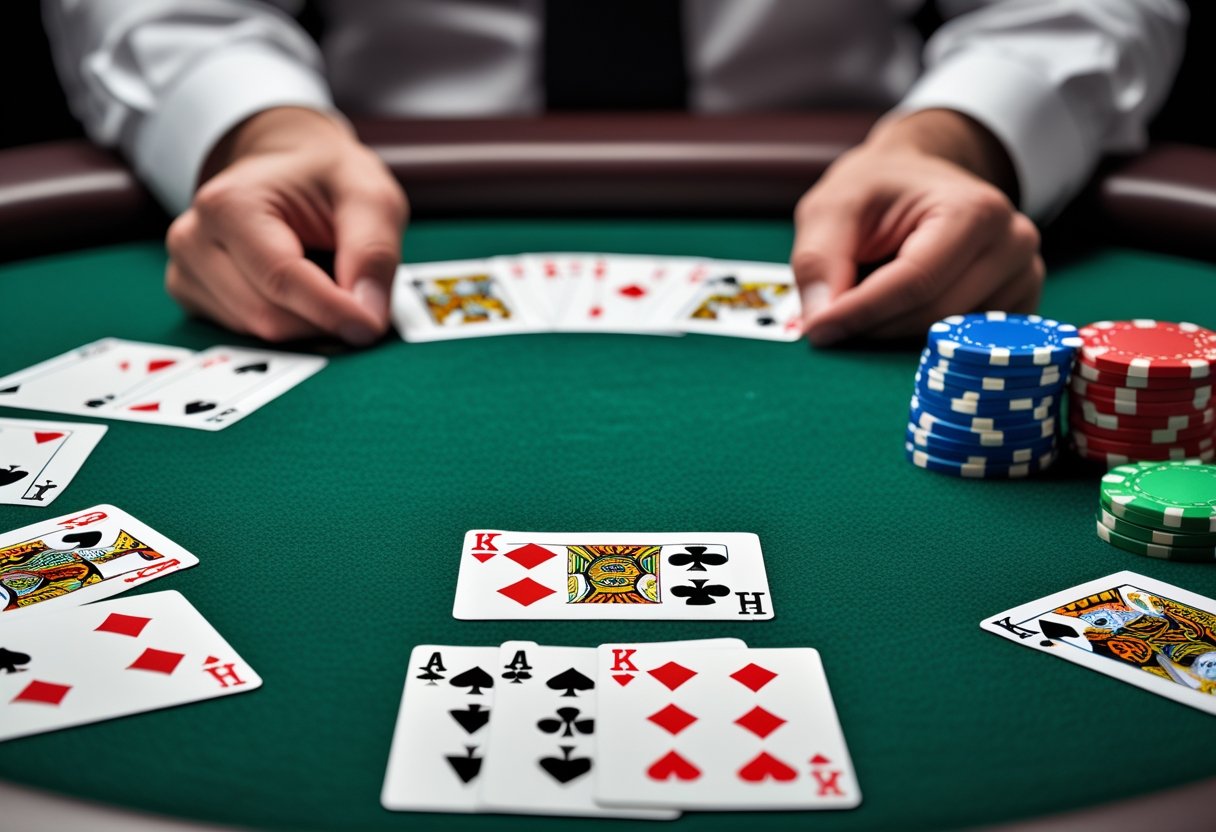
Poker Hand Rankings in Texas Hold’em
Texas Hold’em uses a standard ranking system where five-card combinations determine the winner. Players must understand which hands beat others and how the system ranks cards from strongest to weakest.
How Poker Hand Rankings Work
Texas Hold’em poker hand rankings follow a universal system used across most poker games. Each player makes the best five-card hand using their two hole cards and the five community cards on the board.
The ranking system starts with high card as the weakest hand. It goes up through pairs, two pairs, and three of a kind. Straights and flushes come next, followed by full houses.
Higher-ranked hands always beat lower-ranked hands. When two players have the same hand type, the highest cards within that hand determine the winner.
For example, a pair of kings beats a pair of queens. If both players have kings, the highest remaining card (called the kicker) decides who wins.
Ordering Hands From Best to Worst
The complete poker hand rankings from strongest to weakest are:
- Royal Flush – A, K, Q, J, 10 all in the same suit
- Straight Flush – Five cards in sequence, all the same suit
- Four of a Kind – Four cards of the same rank
- Full House – Three of a kind plus a pair
- Flush – Five cards of the same suit, not in sequence
- Straight – Five cards in sequence, mixed suits
- Three of a Kind – Three cards of the same rank
- Two Pair – Two different pairs
- One Pair – Two cards of the same rank
- High Card – No matching cards, highest card plays
Players should memorize this order completely. It forms the foundation of all poker strategy and decision-making in Texas Hold’em games.
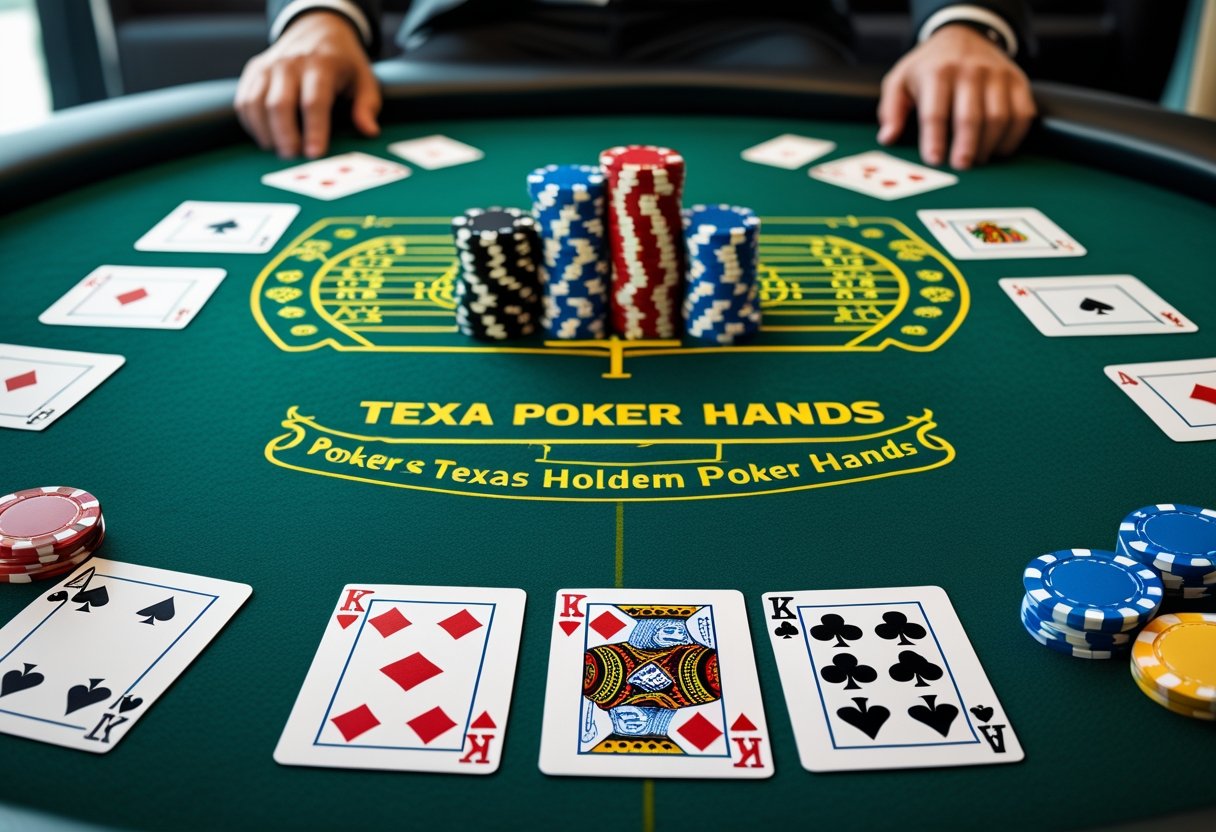
List of Poker Hands
A royal flush stands as the strongest possible hand in poker, containing ace through ten all in the same suit. The next strongest hands are straight flushes and four of a kind, which can both create powerful winning combinations at the poker table.
Royal Flush
A royal flush represents the best possible hand in Texas Hold’em and most poker games. This hand contains five specific cards: ace, king, queen, jack, and ten, all of the same suit.
Only four royal flushes exist in a standard deck. One royal flush can be made in each suit – spades, hearts, diamonds, and clubs.
The odds of getting a royal flush are extremely low. Players have about a 1 in 649,740 chance of making this hand in five-card poker.
Example royal flushes:
- A♠ K♠ Q♠ J♠ 10♠ (spades)
- A♥ K♥ Q♥ J♥ 10♥ (hearts)
When two players both have royal flushes, they split the pot. All royal flushes have equal value regardless of suit.
This hand cannot be beaten by any other combination. Players with a royal flush will always win the hand unless another player also has one.
Straight Flush
A straight flush contains five cards in numerical order, all of the same suit. This hand ranks just below a royal flush in poker hand rankings.
The highest straight flush goes from ace to ten (which makes it a royal flush). The lowest straight flush runs from five down to ace, called a “wheel” or “bicycle.”
Each straight flush gets ranked by its highest card. A queen-high straight flush (Q♥ J♥ 10♥ 9♥ 8♥) beats a jack-high straight flush (J♣ 10♣ 9♣ 8♣ 7♣).
Common straight flush examples:
- 9♦ 8♦ 7♦ 6♦ 5♦ (nine-high)
- 7♠ 6♠ 5♠ 4♠ 3♠ (seven-high)
Players cannot wrap around with straights. A hand like K♥ A♥ 2♥ 3♥ 4♥ does not count as a straight flush.
The odds of making a straight flush are about 1 in 72,193. This makes it one of the rarest hands in poker.
Four of a Kind (Quads)
Four of a kind, also called quads, contains four cards of the same rank plus one other card. This hand ranks third in the standard poker hand hierarchy.
The four matching cards determine the hand’s strength. Four aces beats four kings, which beats four queens, and so on down to four twos.
When players have the same four of a kind, the fifth card (called the “kicker”) decides the winner. Four jacks with an ace kicker beats four jacks with a king kicker.
Four of a kind examples:
- 8♠ 8♥ 8♦ 8♣ A♠ (eights with ace kicker)
- 3♥ 3♦ 3♠ 3♣ 9♥ (threes with nine kicker)
In Texas Hold’em, quads can form when the board shows a pair and a player holds the other two matching cards. They can also occur when the board shows three of a kind.
The chances of getting four of a kind are roughly 1 in 4,164. This makes quads a very strong but achievable hand in poker games.
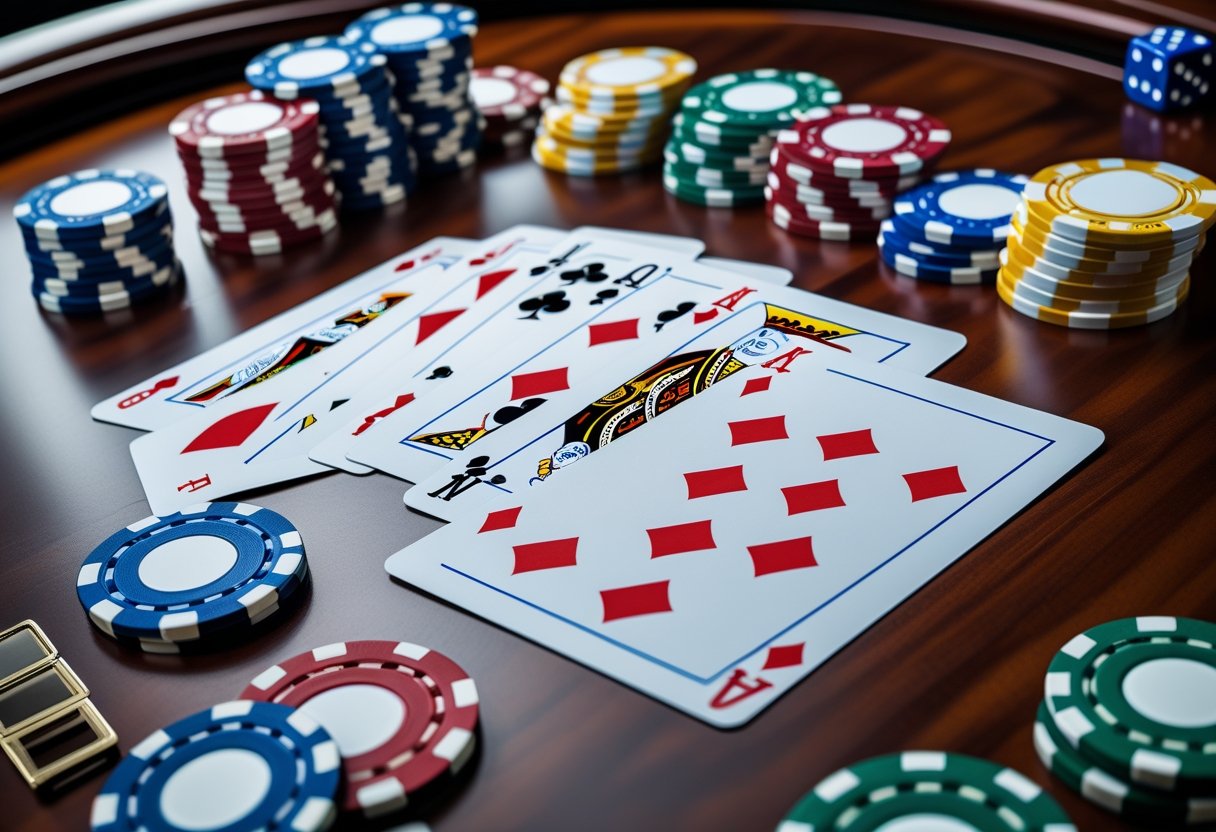
Mid-Strength Poker Hands
These three hands rank in the middle of poker hand strength and can win many pots. They require careful play because stronger hands can beat them.
Full House
A full house combines three cards of one rank with two cards of another rank. This hand ranks as the fourth-strongest poker hand overall.
Examples include three kings with two fives or three aces with two sevens. Players often call this hand “a boat” or “a full boat.”
When full houses compete, the three-card set determines the winner. Three queens with two twos beats three jacks with two aces.
Full houses occur in about 0.14% of all dealt hands. Most players win big pots with this hand because opponents often hold strong but weaker hands.
The hand appears more often in Texas Hold’em when pairs show up on the board. Players should bet aggressively with full houses since few hands can beat them.
Flush
A flush contains five cards of the same suit in any order. This hand ranks fifth in poker hand strength.
All hearts, all spades, all diamonds, or all clubs make a flush. The highest card in the flush determines the winner when multiple players have flushes.
An ace-high flush beats a king-high flush. If the highest cards match, players compare the second-highest cards, and so on.
Flushes happen in about 0.20% of hands. They can be tricky to play because straight flushes and full houses beat them.
Players need at least three suited cards on the board to make a flush in Texas Hold’em. Watch for possible straight flushes when the board shows connected suited cards.
Straight
A straight uses five cards in sequence regardless of suit. This hand ranks sixth among all poker hands.
The sequence can be A-2-3-4-5 (called a wheel) up to 10-J-Q-K-A. The ace can be high or low but cannot wrap around (K-A-2-3-4 is not valid).
The highest card in the straight wins when multiple straights compete. A jack-high straight beats a ten-high straight.
Straights occur in about 0.39% of all hands. They lose to flushes, full houses, and better hands.
Connected cards on the board create straight possibilities. Players should be cautious with low straights since higher straights can beat them easily.
Common and Lower Poker Hands
These four hands make up the majority of poker hands players receive. While they rank lower than premium hands like straights and flushes, they still win many pots and form the backbone of most poker sessions.
Three of a Kind
Three of a kind consists of three cards with the same value plus two unmatched cards. Players also call this hand “trips” or “a set” depending on how they make it.
This hand beats two pair, one pair, and high card hands. It loses to straights, flushes, full houses, four of a kind, straight flushes, and royal flushes.
Example hands:
- Three kings with a 7 and 4
- Three fives with an ace and jack
- Three twos with a queen and 9
When two players have three of a kind, the higher three cards win. Three queens beat three jacks. If both players have the same three of a kind, the highest side card determines the winner.
The remaining two cards serve as kickers. If one player has three aces with a king and the other has three aces with a queen, the king kicker wins.
Two Pair
Two pair contains two cards of one rank, two cards of another rank, and one unmatched card. This hand appears frequently in poker games and often wins small to medium pots.
Two pair beats one pair and high card hands but loses to three of a kind and all higher-ranked hands. Players need to understand how to compare two pair hands when multiple players have them.
Comparison rules:
- Higher top pair wins first
- If top pairs match, higher second pair wins
- If both pairs match, highest kicker wins
For example, kings and fives beats queens and jacks. If both players have kings and fives, the player with the higher fifth card wins the pot.
Two pair hands can be tricky to play. They have decent strength but remain vulnerable to three of a kind, straights, and flushes.
One Pair
One pair consists of two cards with matching ranks plus three unmatched cards. This hand wins more often than high card but loses to all other poker hands.
The pair’s rank determines the hand’s primary strength. A pair of aces beats a pair of kings. A pair of kings beats a pair of queens, and so on down to a pair of twos.
Kicker cards matter: The three remaining cards serve as tiebreakers when players have the same pair. The highest unpaired card wins first, then the second highest, then the third.
If one player has pocket aces with a king kicker and another has pocket aces with a queen kicker, the king kicker wins. Players must pay attention to their kickers, especially with lower pairs.
One pair hands require careful play. High pairs like aces or kings play strongly, while small pairs often need improvement to win large pots.
High Card
High card is the lowest possible poker hand. It occurs when a player’s five cards don’t form any other combination. The highest card in the hand determines its value.
Ace high represents the strongest high card hand. King high ranks second, followed by queen high, jack high, and so on down to seven high as the weakest possible hand.
When comparing high card hands, players examine each card from highest to lowest. If the highest cards match, they compare the second highest cards, then the third, fourth, and fifth if necessary.
For example, ace-king-queen-jack-nine beats ace-king-queen-jack-eight. The ninth card outranks the eighth card as the final tiebreaker.
High card hands rarely win at showdown except in specific situations. They work best as bluffs or when all players check to showdown with weak holdings.
Most players fold high card hands when facing bets unless they have strong draws to better hands like straights or flushes.
Best Starting Hands in Texas Hold’em
The top starting hands in Texas Hold’em give players the best chance to win before any community cards are dealt. Understanding which two-card combinations perform strongest helps players make better decisions and avoid costly mistakes.
Top Starting Hands
Pocket Aces (AA) rank as the best starting hand in Texas Hold’em. This hand wins about 31% of the time against nine random opponents.
Against specific hands, pocket aces dominate even more:
- AA vs KK: Aces win 80% of the time
- AA vs AK: Aces win 87% of the time
- AA vs any pocket pair: Aces win 80% of the time
Pocket Kings (KK) come second with a 26% win rate against nine opponents. Kings beat every hand except aces.
The main danger with kings is when an ace appears on the flop. Players call kings “ace magnets” because aces seem to show up often.
Pocket Queens (QQ) rank third at 22% against nine hands. Queens face more problems than kings or aces.
Both aces and kings on the board create danger. Queens also struggle against AK, which creates a coin flip situation.
Ace-King Suited (AKs) takes fourth place at 20.2%. This hand offers great potential for straights and flushes.
When AK hits the flop, it makes top pair with top kicker. This combination beats most other paired hands.
Pocket Jacks (JJ) round out the top five at 19.1%. Many players struggle with jacks because they’re hard to play correctly.
Jacks perform well but any overcard on the flop creates difficult decisions.
Why Starting Hands Matter
Starting hands determine a player’s chances before seeing the flop. Strong hands like pocket pairs and big aces win more often than weak combinations.
Position affects how players should play their starting hands. Premium hands work well from any position, while marginal hands need good position to be profitable.
Stack sizes also influence starting hand selection. Short stacks can push all-in with hands like AK or pocket pairs. Deep stacks allow for more complex post-flop play.
Players who understand starting hand strength make fewer mistakes. They fold weak hands that lose money over time and play strong hands more aggressively.
The difference between winning and losing players often comes down to hand selection. Good players fold most hands and only play the strongest combinations.
Kickers and Hand Comparisons
When two players hold the same poker hand type, kicker cards determine the winner. These extra cards can make the difference between winning a big pot and losing everything.
How Kickers Break Ties
A kicker is the highest card that doesn’t contribute to the main poker hand. It acts as a tiebreaker when players have identical hand types.
In one pair hands, three cards serve as kickers. If two players both have a pair of Kings, the highest remaining card wins. A player with K-K-A-7-5 beats K-K-Q-J-9 because the Ace kicker is higher than the Queen.
Two pair hands use one kicker card. When players have the same two pairs, the fifth card decides the winner. For example, K-K-8-8-A defeats K-K-8-8-7 due to the Ace kicker.
Three of a kind uses two kickers. If both players have three Jacks, the two remaining cards determine victory. J-J-J-A-K beats J-J-J-A-Q because the King kicker outranks the Queen.
Kicker rules don’t apply to all hands. Straights, flushes, full houses, four of a kind, and straight flushes have specific comparison methods that don’t rely on kickers.
Examples of Kicker Impact
Consider a Texas Hold’em scenario where the board shows A-7-7-3-2. Player 1 holds A-K while Player 2 has A-Q. Both players have two pair: Aces and sevens.
The King kicker gives Player 1 the winning hand. This single card difference can mean winning or losing hundreds of dollars in a cash game.
Another example involves pocket pairs. Player 1 has 9-9 and Player 2 holds 9-8. If the board comes 9-5-3-2-A, Player 1 wins with three nines and Ace-five kickers. Player 2 has three nines with Ace-eight kickers.
Kicker strength matters most in close decisions. Players often underestimate how frequently kicker cards determine the outcome. In limit poker games, kicker awareness can improve win rates significantly.
Smart players consider kicker strength when choosing starting hands. A-K dominates A-Q because the King kicker wins when both players hit their Ace.
Probability and Rarity of Poker Hands
The chances of making different poker hands vary dramatically, with a royal flush occurring once every 649,739 hands while one pair appears in roughly 42% of all five-card combinations. Hand frequencies directly determine poker hand rankings, as rarer combinations beat more common ones.
Odds for Each Hand Type
The odds of making specific hands in five-card poker follow a clear pattern. Royal flush stands as the rarest hand with odds of 649,739 to 1 against.
Straight flush comes next at 72,192 to 1 odds. Four-of-a-kind occurs much more frequently at 4,165 to 1 against.
Full house appears once every 694 hands. Flush and straight hands have similar odds at 509 to 1 and 255 to 1 respectively.
Three-of-a-kind happens about once every 46 hands. Two pair occurs roughly once in 20 hands.
One pair is the most common made hand in poker. It appears in over 42% of all five-card combinations with odds of only 1.37 to 1 against.
High card hands make up about half of all possible combinations. These occur when no other hand can be formed.
Understanding Hand Frequencies
Texas hold’em uses the same probability calculations as five-card draw poker. There are 2,598,960 total possible five-card combinations from a standard 52-card deck.
Only 4 ways exist to make a royal flush – one for each suit. This explains why most players never see this hand in their lifetime.
Straight flush has 36 possible combinations when excluding royal flushes. Four-of-a-kind can be made 624 different ways.
Full house combinations total 3,744 possibilities. Regular flush hands can be formed 5,108 ways, while straights have 10,200 combinations.
The math behind these frequencies determines which hands beat others in poker hand rankings. Rarer hands always rank higher than more common ones.
Frequently Asked Questions
New poker players often have questions about hand strength, starting card selection, and how different combinations rank against each other. These common questions cover the basic rules that every player needs to know before sitting down at a Texas Hold’em table.
What are the top starting hands in Texas Hold’em poker?
The best starting hands in Texas Hold’em are pocket aces, pocket kings, and pocket queens. These three hands give players the strongest position before the flop.
Ace-king suited follows as the fourth-best starting hand. Other strong starting hands include ace-king offsuit, pocket jacks, and ace-queen suited.
Pocket tens and pocket nines also rank as premium starting hands. Players should play these hands aggressively in most situations.
Can you list the Texas Hold’em hands in descending order of strength?
The complete ranking from strongest to weakest is royal flush, straight flush, four of a kind, full house, flush, straight, three of a kind, two pair, one pair, and high card.
A royal flush contains ace, king, queen, jack, and ten all in the same suit. This hand cannot be beaten by any other combination.
A straight flush has five cards in sequence, all of the same suit. Four of a kind means four cards of the same rank plus one other card.
Where can I find a reliable Texas Hold’em starting hands chart?
Most poker training sites offer free starting hands charts that show which cards to play from each position. These charts help beginners learn proper hand selection.
Poker books and strategy guides also include detailed starting hand charts. Many experienced players recommend printing these charts for quick reference during play.
Mobile poker apps often include built-in hand strength calculators and starting hand guides. These tools help players make better decisions at the table.
What is the ranking of poker hands for Texas Hold’em from highest to lowest?
Texas Hold’em uses the standard poker hand rankings that apply to most poker games. The hierarchy starts with royal flush at the top and ends with high card at the bottom.
Full house beats flush, which beats straight, which beats three of a kind. Two pair beats one pair, and one pair beats high card only.
When players have the same type of hand, the higher cards within that hand type determine the winner. For example, a pair of kings beats a pair of tens.
What are the rules for hand rankings in Texas Hold’em?
Players must make the best five-card hand using any combination of their two hole cards and the five community cards. They can use both hole cards, one hole card, or no hole cards.
The player with the highest-ranking five-card hand wins the pot. If two players have identical hand types, the player with higher cards wins.
Suits have no ranking value in Texas Hold’em. A flush in hearts has the same value as a flush in clubs if the card ranks are identical.
How is a full house ranked against other hands in Texas Hold’em?
A full house ranks fourth in the poker hand hierarchy. It beats flush, straight, three of a kind, two pair, one pair, and high card.
Only three hands can beat a full house: royal flush, straight flush, and four of a kind. This makes a full house a very strong hand in most situations.
When comparing full houses, the three-card set determines the winner first. If both players have the same three-card set, the pair determines the winner.